Parent Guide
Repeating Pattern Activities for Kids Ages 3–7
Explore repeating patterns with shapes, laundry and sounds. Five relaxed activities for children aged 3–7, with no special equipment.
A sock, a washcloth, another sock, another washcloth: an ordinary laundry pile can become a small mathematical puzzle. What keeps repeating? What would belong next?
Repeating pattern activities give children something to notice, describe and create. You do not need worksheets or a special toy. A few familiar objects, a little space and a willing play partner are enough.
The activities below offer different starting points for children aged 3–7. Choose by your child’s interest and experience rather than treating age as a deadline.
What Is a Repeating Pattern?
A repeating pattern has a group that appears again in the same order. In “circle, square, circle, square, circle, square,” the repeating unit is “circle, square.”
Adults sometimes call this an AB pattern. The letters stand for different elements; children do not need to read them. An AAB pattern could be “circle, circle, square,” repeated. An ABB pattern could be “circle, square, square,” repeated.
The useful question is not only “What comes next?” It is also “Which little group keeps coming back?” That repeating unit is central to the explanation in Stanford DREME’s pattern guide.
Set Up a Small, Comfortable Invitation
Choose two kinds of large, easy-to-handle objects. Rolled socks and washcloths work well. You could also use large toy blocks or large paper shapes.
Keep the first example simple. Show the unit three times so your child has several opportunities to notice the rule. Leave extra objects nearby.
Supervise the activity and avoid small loose parts if your child still mouths objects. For visual patterns, use differences in shape or texture as well as colour, so colour is not the only clue.
Five Ways to Explore Repeating Patterns
1. Make a Laundry Trail
Arrange a rolled sock, then a folded washcloth. Repeat that pair twice more.
Say the objects’ names as you point along the trail. Invite your child to build a matching trail underneath yours. Then ask whether they would like to add another whole pair.
If copying feels difficult, build together. You can place the sock while your child adds the washcloth. There is no need to hide the example or turn it into a memory challenge.
2. Find the Smallest Repeating Group
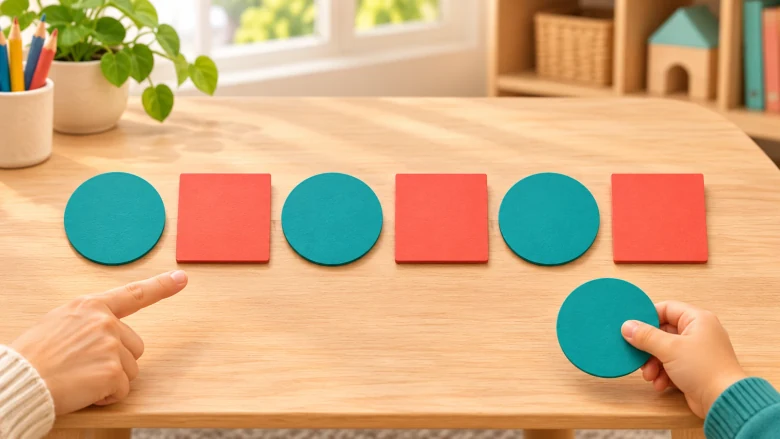
Draw large circles and squares on paper:
Circle, square, circle, square, circle, square.
Ask, “Can we put a little frame around the part that keeps repeating?” Use your fingers to frame the first circle and square, then move that frame along the row.
If your child frames four shapes, acknowledge that those repeat too. Then explore whether a smaller group works. This keeps the conversation about the structure rather than whether an answer is right or wrong.
3. Become Pattern Repairers
Build a complete AB pattern with large shapes. Let your child look at it before you remove one shape from the middle.
Offer a circle and a square beside the gap. Ask, “Which one would keep our pattern going?”
Read the whole row together after the repair. Later, swap roles and let your child make a gap for you. You can explain your choice aloud without asking them to produce a formal explanation.
4. Give the Pattern a Soundtrack
Choose two comfortable actions, such as clapping and tapping your knees. Repeat “clap, tap” several times together.
Then look back at your circle–square row. Can a clap stand for each circle and a tap for each square?
You are exploring whether the same repeating rule can appear in a different form. If sound is uncomfortable, use two quiet gestures instead. Seated movements work too. England’s early-years pattern guidance also includes movement and rhythm as ways to explore patterns.
5. Open a Pattern Design Studio
When alternating patterns feel familiar, offer a new design: circle, circle, square; circle, circle, square; circle, circle, square.
Compare it with circle, square, square repeated three times. Both use circles and squares, but their repeating units differ.
Invite your child to invent a border for a drawing using either rule, or create their own. Ask them to show where the pattern starts again. You can copy their design and let them check your work.
When Your Child Chooses Something Unexpected
Pause before correcting. Ask, “Tell me about your pattern,” or invite your child to point to the repeating part.
They may be following a feature you missed, such as size. They may also be making a picture rather than a repeating pattern. You can appreciate the picture and offer to build a repeating row together afterwards.
To simplify, return to two clearly different objects and copy side by side. To extend, change the materials while keeping the same rule. A longer row is not always a more interesting challenge.
Connect Pattern Play with Everyday Maths
Keep counting and numeral recognition available as separate activities. After making a pattern, you might count its objects together, then return to describing its repeating unit.
Our guide to number recognition and counting explores those related skills. For another day, try these number activities at home.
There is no need to complete every activity. Choose one, follow your child’s ideas and stop when interest fades. A familiar pattern can be waiting in tomorrow’s laundry pile.
Sources and Further Reading