
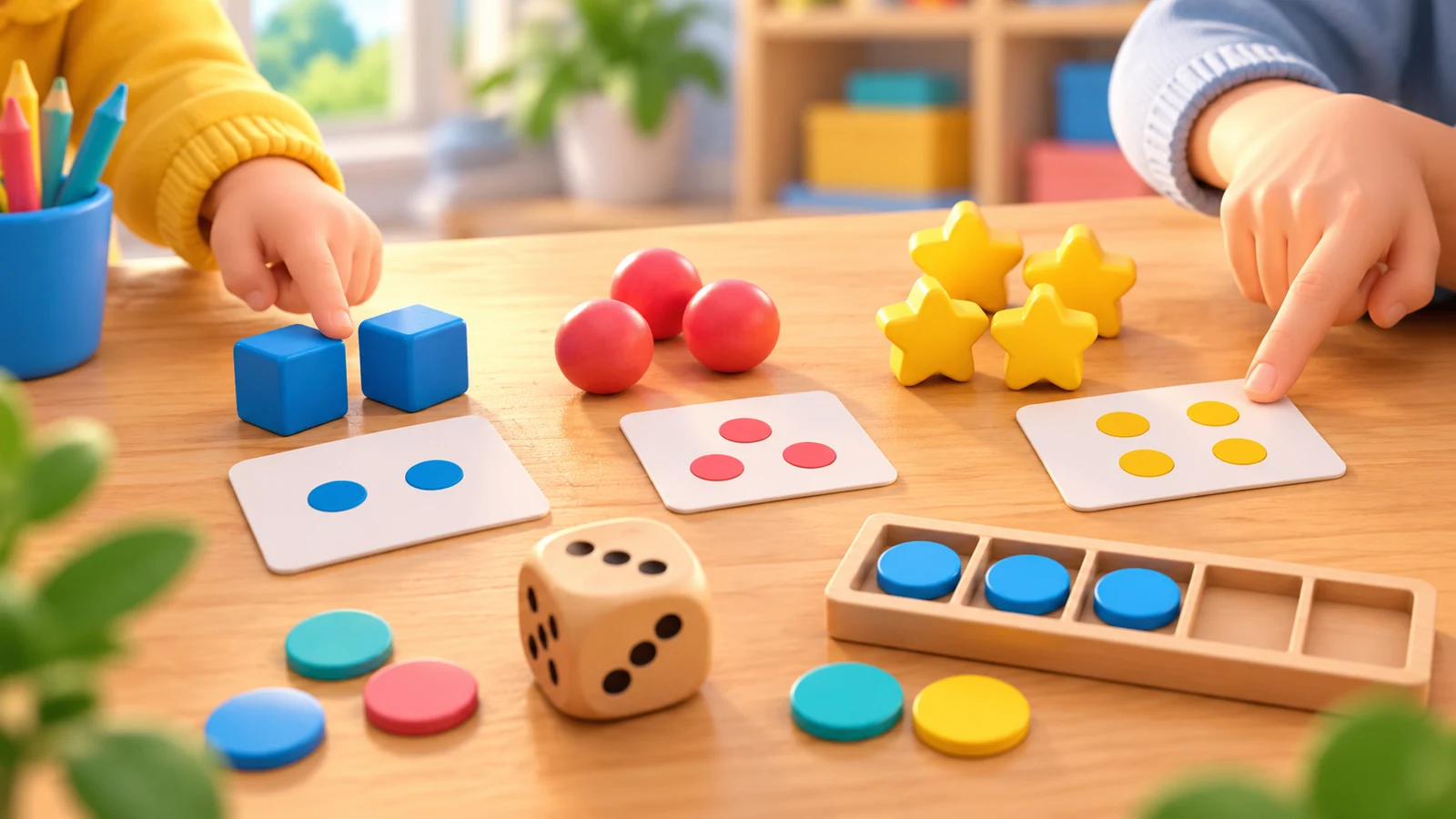
Sometimes a child looks at three toy cars and says “three” straight away — without pointing to each car or counting aloud. That quick sense of “how many” is called subitizing.
Subitizing usually begins with very small groups. It is not a race, a trick or a replacement for counting. It is one more way children can build a flexible understanding of quantity through familiar patterns and playful moments.
The six activities below need little preparation. Keep each one brief, follow your child’s interest and return to counting whenever a group feels too difficult to recognise at a glance.
What Is Subitizing?
Subitizing means recognising a small quantity without counting the items one by one. Adults often do this automatically when they see the dots on a die. We do not usually count each dot in a familiar pattern; we simply notice the amount.
Preschoolers can begin to notice small groups in the same way. At first, groups of one, two or three are a useful place to start. Familiar arrangements — such as dots on dice, fingers on a hand or objects placed in a simple line — may become easier to recognise with repeated, relaxed practice.
There is no need to push larger groups. If your child counts the objects, that is still valuable mathematical thinking.
How Is Subitizing Different from Counting?
Counting asks a child to match one number word to each object and understand that the final number tells how many objects there are. Subitizing is the immediate recognition of a small amount.
The two skills support each other. A child might recognise two dots instantly, then count four dots to check. Over time, familiar small groups can also help children see that a quantity stays the same even when the objects are rearranged.
Written numerals are another connected but separate idea. Our guide to number recognition and counting explains why saying number words, understanding quantities and identifying symbols can develop at different speeds.
Six Playful Subitizing Activities
1. Flash a Dot Card
Draw one to five dots on small pieces of card. Show one card for a moment, hide it and ask, “How many did you see?”
Begin with one to three dots. If your child wants to count, show the card again and count together. The goal is curiosity, not speed.
2. Roll, Look and Cover
Roll a standard die. Invite your child to say the quantity, then cover the die with a cup. Ask them to show the same amount with fingers, blocks or buttons.
This connects a familiar dot pattern with another representation of the same quantity.
3. Try a Snack-Time Glance
Place two, three or four crackers or fruit pieces on a plate. Ask, “How many do you see?” before anyone starts eating.
Change the arrangement on another day and keep the moment pressure-free.
4. Match Different-Looking Quantities
Make two cards that show the same number in different ways: three dots in a row and three dots in a triangle, for example. Ask your child whether the cards show the same amount.
Let them count to check. This helps draw attention to quantity rather than a single memorised pattern.
5. Make a Movement Snapshot
Clap, tap or jump a small number of times, then pause. Ask, “How many?” Try two or three movements first.
This lets children experience quantity through sound, movement and sight.
6. Build the Same Number in Different Ways
Choose a small number and build it with several materials: four blocks, four toy animals and four buttons. Place the groups side by side and talk about what is the same and what looks different.
For more low-preparation ideas, explore our playful number activities for home and the Find the Number activity.
Questions That Encourage Thinking
Simple questions can keep the activity conversational:
- How many do you see?
- How did you know?
- Can you make the same amount another way?
- Do these two groups have the same number?
- What changes if we move the objects?
“How did you know?” does not require a formal explanation. A child might say, “I saw two and one,” point to a familiar pattern or decide to count.
What If My Child Counts Every Object?
Let them count. Counting is not a mistake and there is no need to stop it.
Use smaller groups, repeat familiar patterns and give your child enough time to look. You can model your own thinking without demanding an answer: “I saw two dots, and one more. That makes three.”
Children develop at different rates. Short, enjoyable encounters are more useful than turning the activity into a test. If your child loses interest, pause and try again another day.
Connecting Quantities, Numerals and Games
Subitizing focuses on quantities, while number recognition focuses on written symbols. You can connect the two by placing the numeral 3 beside a group of three objects, then asking your child to find another group of three.
Games can offer another setting for talking about numbers, but they do not need to carry every learning goal. Number Catcher invites players to look for and catch a target numeral; it can sit alongside hands-on play, books and everyday conversations. You can also browse the studio’s games portfolio to see what is available now and what is still in development.
Keep “How Many?” Playful
Subitizing grows through many small experiences: a quick look at dice, a few toys on the floor, fingers held up during a song or snacks arranged on a plate.
Start with tiny groups. Welcome counting. Repeat favourite patterns, but also change the spacing and arrangement. Most importantly, finish while the activity still feels like play.
Noticing “how many” at a glance is not about answering fast. It is about helping quantities become familiar, meaningful and easy to talk about.
Sources and Further Reading
Explore More Playful Number Ideas
Find practical family activities, Number Catcher and more stories from Shodoa Games.
Explore Our Games