
Parent Guide
Which Has More? 3 Games for Comparing Quantities
Pair toy blocks, stretch a row, and help two bears get the same number. Three games for ages 3–7.
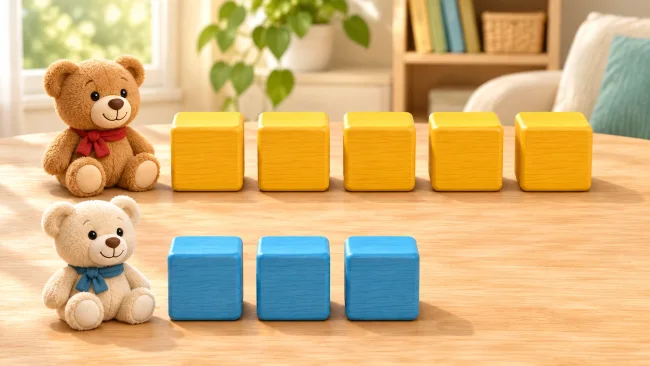
Two toy bears are building dens. One has five blocks and the other has three. Before you count either pile, ask your child, “Can you show me which bear has more?” Slide the blocks into two rows and put one block from each bear side by side. When one row runs out, the two blocks left without partners tell the story.
That’s a way to compare quantities by pairing objects one at a time. These games for ages 3–7 let children try it with toys, see how spacing changes the look of a group, and work out how to give two toys the same number of blocks. You’ll need a clear spot on the floor or table, two toys, and a handful of large blocks your child can handle comfortably. Pick one game to start.
Game 1. Give every block a partner
Give one toy four blocks and the other toy two. Make a row in front of each toy. Start both rows at the same end and slide the blocks into pairs, with one block from each row in every pair. You can make the first pair and invite your child to make the next.
Pause when the shorter row runs out. “These two blocks have no partners. This bear has more blocks. The other bear has fewer.” Point to the toys as you say each sentence. Swap which toy has more in the next round.
Try three blocks for each toy. “Every block has a partner. They have the same number.” If your child picks one toy anyway, point together to each pair and see whether any block is left without a partner. If your child would rather count, count each row and use the pairs to show why the totals match.
For a closer look at counting, read about how counting and number recognition differ.
Game 2. Stretch a row and check again
Put four blocks in each of two rows and line them up in pairs. Ask your child to watch as you slide the blocks in one row farther apart. “This row takes up more space. Does it have more blocks?”
Give your child time to show you what they think. They might push the blocks back into pairs, touch each block as they count, or tell you they watched all four stay on the table. You can model any of those checks together. “We moved the blocks. We didn’t add any or take any away. There are still four in each row.”
When that feels familiar, spread out a row of three blocks until it stretches farther than a closely packed row of four. Ask two separate questions. “Which row is longer? Which row has more blocks?” Let your child bring the rows back together to check. A row can be longer and still have fewer blocks.
For another way to find how many are in one group, try these activities for seeing small quantities at a glance.
Game 3. Give both bears the same number
Return to five blocks for one bear and three for the other. Say, “Both bears want the same number for their dens. Can you make that happen using the blocks we already have?” Pair the blocks again so your child can see the two extras on one side.
Invite your child to move one block from the group of five to the group of three. Check by pairing or counting. Both bears now have four. Point to each bear as you explain. “This bear gave away one. That bear got one.” Moving a single block changes both groups.
If your child suggests fetching more blocks, try that as a separate round. Start again with five and three and leave every block with its original bear. Ask how many new blocks the bear with three needs to catch up. It needs two to get to five. Compare the two rounds aloud. “We moved one when one bear gave a block away. We added two when the first bear kept all five.”
Follow your child’s way of checking
For a child just getting started, use one block and three blocks, then try two and two. You can do the moving while your child points to the partners. If the comparison words are new, say the full sentence together or let your child show you the unpaired block. For a child who is ready for a challenge, try groups that differ by only one and ask them to make a round for you.
You can use the same idea while putting away toys or setting the table. Try putting one napkin beside each plate and asking, “Do we have enough napkins for all the plates?” A plate without a napkin tells you what to do next.
For another day, here are more number games to try at home.