
Parent Guide
What Happened Next? Story Retelling After a Cartoon
Watch one cartoon scene together, then try simple prompts, three-panel drawings or pretend play to retell the story with kids ages 3–7.
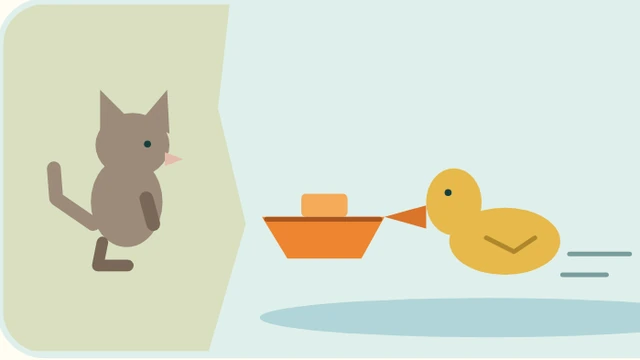
Your child laughs when a duck pushes a toy boat back to shore. As the credits start, you say, “That boat got away from the cat. How did it get back?” Your child makes a quacking sound and pushes a hand across the sofa. You’ve already started retelling the story together.
If your family is already planning to watch a cartoon, try using one scene as the starting point for a little conversation or pretend play. For children ages 3–7, the same scene can offer different ways to join in. One child might make the duck’s sound. Another might draw what happened or tell the story from the duck’s point of view.
Choose one scene with a clear change
Pick a familiar, age-appropriate cartoon and look for a scene where you can see what changes. In our made-up example, a cat puts a toy boat in a pond. A gust blows it away from the bank. A duck nudges it back. There’s a beginning, a problem and an ending you can show with a few gestures.
If the episode has several storylines, choose just one small moment your child enjoyed. A mostly wordless scene can work, too. Sit where you can both see what’s happening, and talk in whatever language feels natural at home. You can also use the same approach with a scene from a picture book or a story you tell aloud.
Pause once or talk after the scene
If your child enjoys pausing, try it at a natural break. In the boat story, stop after the boat drifts away. Try one invitation. “Oh, the boat’s getting farther away. What could the cat do?” Give your child a moment to answer, point or show you with a gesture. Then watch how the scene ends.
You can let the whole scene play and talk afterwards. A comment is an easy way in. “I liked how the duck came over when the boat floated away.” If your child is more interested in the splash the duck made, start there. “I saw that splash, too. Let’s show what the duck did with its beak.” The American Academy of Pediatrics’ family guidance on watching together suggests following children’s interests and leaving room to watch quietly. AAP family guidance on co-viewing
Tell it back with first, next and last
Once the scene is over, turn off the screen. Start the story and leave a space for your child to join. “First, the cat put the boat in the pond. Next, the wind blew it away. And last…” Your child might say “the duck,” make the boat move with a hand, or show you the moment with a toy. Pick up what they offer. “Yes, the duck nudged it back to the bank.”
If three events feel like a lot, start with two moments. “The boat floated away. Then the duck brought it back.” You can tell both parts yourself and invite your child to do the duck’s part. If your child wants more of a challenge, ask how one event led to another. “Why did the duck need to push the boat?” The Illinois Early Learning Project offers more ways to use sequence words and retell familiar stories. Illinois Early Learning Project on sequencing
Draw three moments or act them out
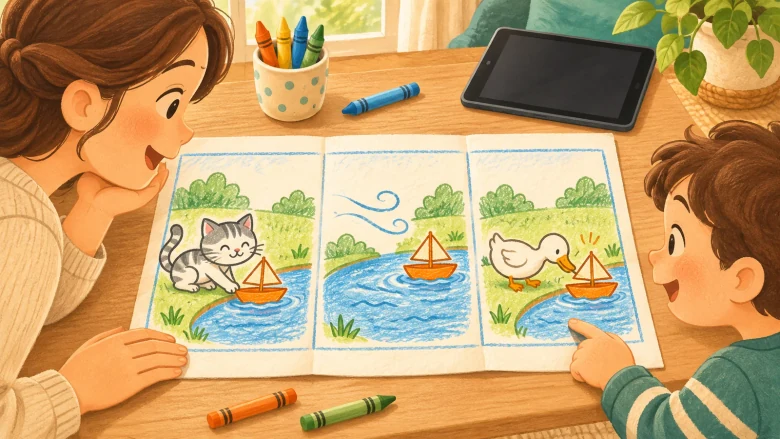
Fold a sheet of paper into three panels. Draw a quick boat near the bank in the first panel. In the middle, add a few lines for wind and draw the boat farther away. In the last, draw the duck nudging the boat back. Your child can draw one panel, point while you sketch, or tell you what to add. Ask them to show you the pictures in story order and tell the story together.
For an acting version, put a folded towel on the table as the pond and use large toys for the characters. A scrap of paper can be the boat. Let your child choose who plays the wind. If they invent a new ending, give it a turn. “In our new story, the cat builds a bridge to reach the boat. What happens after that?”
Follow what your child wants to share
If your child begins with the ending, join them there. “The duck saved the boat! I remember what happened just before that.” If they want to show just one moment, let that be the whole activity. You can leave the drawings on the table and come back to them another day.
Later, try telling a tiny story about something you did together. “First we put on our boots. Next we walked to the park. Last we jumped in a puddle.” Give your child the last line if they want it. They might tell you about the splash, just like they did with the duck.
TRY THE GAME
Mossy’s Story Trail
For a playful companion to this activity, try Mossy’s Story Trail: watch a picture sequence, remember what happened and choose a new ending.
Play NowPrivacy for parents